The call usually comes at the wrong time. Someone is on the phone saying a back tooth is moving, and it's the implant one, and they're already halfway to believing the whole thing is failing out of their head. You've taken that call more times than you can count. And before you've seen a radiograph or laid a hand on it, you already have a shortlist in your head: an abutment screw that has lost its preload, a crown that has come off its cement, or — much less often — something happening at the fixture itself. Three very different problems that all feel identical to the person holding the phone.
Then comes the second half of the call, the one your front desk fields all day: what's this going to cost me. And you know the honest answer is that it depends on what is actually loose, and nobody can tell that down a phone line.
The answer you give before they sit down
A screw-retained crown with an intact screw is the short visit. Open the access channel, clear the composite and the polytetrafluoroethylene tape, check the screw and the seating surface, re-torque to the manufacturer's spec with a calibrated driver, verify the occlusion, reseal. If everything checks out, that is chairside time and not much else.
A cement-retained crown that has lifted is a different conversation, because now you're deciding whether to cut an access hole to reach the screw or take the whole unit off. A fractured screw is a different conversation again — retrieval, and sometimes a new abutment. Same complaint, same phone call, three different quotes. That's not you being evasive. That's the honest structure of the job.
The questions your front desk answers a thousand times a week
When we get calls, people often ask whether it's normal for an implant crown to come loose at all. You know the answer: a screw that backs off is a mechanical event, not a verdict on the implant, and it's one of the more ordinary things that happens over the life of a restoration. Occlusal load, a cantilevered contact, a screw that never reached full preload the first time — there are reasons, and most of them are fixable.
And they ask whether it's an emergency. Your answer is measured, because it isn't a bleeding emergency, but it also isn't a wait-a-month problem. Movement means micro-motion at the interface, and micro-motion invites soft tissue in, food in, and eventually a screw that fatigues and snaps. Get seen soon. Don't chew on it. Don't let anyone tell you to leave it until it hurts.
All of that lives in your head and nowhere else
Here's the part worth sitting with. Everything above — the shortlist, the three price paths, the reason a loose crown isn't the same as a failing implant — you deliver that cleanly, out loud, several times a week, for free, to whoever happens to be in front of you. It is muscle memory. You've never had to think about how to say it.
Which is exactly why it has never been written down. Your website has hours, a phone number, a services list. It does not have the thing you're genuinely expert at. Not because you didn't want it there. Because you were never sitting still long enough to type it, and nobody ever told you that the explaining itself was the asset.
What's directly below this, and why it's there
So here's the question I'd actually ask you if we were standing at a supply counter: if you already know this cold, and the person searching for it tonight at eleven o'clock has no idea you exist — where exactly is the gap?
Underneath this paragraph is something called the Top Maps Recipe. It came from a simple, unglamorous exercise: going and looking at the businesses in a trade who are already being found, market after market, and counting what they actually have — how much they've written, how many places their name is listed correctly, what they've put on video, how their reviews are handled. Not theory. A count. Put in a website address, pick your trade, and the winning Top Maps Recipe for your own trade is right there in front of you.
YOUR TRADES CALCULATED TOP MAPS RECIPE
Calculated Not Guessed
See the data that your Blog Scoreboard App is calibrated against
Where you stand
Your own numbers, next to the Top Maps Recipe.
Every number on your side was taken off your own business while you were answering.
You've seen it now. That's the shape of it — the same handful of ingredients, in the same proportions, for the people already being found in your trade. Nothing mystical in there. Just a list of things that got done.
So there, let me ask you the thing that matters more than the list. What would your practice look like if people landed on your website today, and again tomorrow, all of them already looking for exactly what you fix? Not calls you chased. People who arrived because you'd already answered their question before they picked up a phone.
Knowing it cold and being FOUND are two different things
Nobody kept you in the dark on purpose out of malice. It's just that the people who understood how being found actually works had no particular reason to explain it to you, and Google was never going to publish the instructions. Meanwhile you were doing the work. That's not a failing. That's a full schedule.
But it does leave one hard fact sitting there. What you know about a loose abutment screw is worth exactly nothing to a stranger typing at midnight, because none of it exists anywhere that stranger can reach. The gap was never your knowledge. The gap is a page that hasn't been written yet.
Why one post is never the point
This post you're reading is not a standalone. It sits underneath a broader piece and beside others, all pointing at each other — the thick file, not the cover page. One article is an opinion. A stack of them, all answering real questions in your own words, is a proof stack. That's where gravity and pull come from: not one clever page, but a body of work that keeps accumulating. And the floor only rises, because nothing you publish ever un-publishes itself.
Visibility isn't a feeling. It's measurable. You can watch it move, the same way you'd watch a scoreboard.
What the app that gets you found is showing you — free to open
As of right now this single page has been read times today, times yesterday, and times in total — real figures, updating as people arrive. The app that gets a whole cluster like this one written and found for your own practice opens from the strip at the bottom of your screen, free. Tap any number and it opens up and shows you how that number was worked out, no hand-waving. Tap through and the rows behind it open, all of them your own records.
Before you open it, answer one honestly, in your own head. Which of these is you right now: "I have no idea whether anyone finds me online"; "I assume I show up somewhere, I've just never checked"; "I've checked, and I didn't love what I saw"; "I know exactly what comes up when someone searches my name and my city."
What your answer actually tells you
Whichever one you picked, notice that all four of them are about information, not about ability. Nobody picked "I'm bad at dentistry." The uncertainty isn't about the work — it's about whether the work is visible, and that is a question with a real, countable answer instead of a shrug.
Which brings the last question of this section, and it's a genuine one. If the numbers for your own practice were sitting right there, already worked out, would you want to look at them?
You've had the week you've had. Emergencies squeezed between columns, a lab case that came back wrong, somebody's loose crown at 4:40 on a Friday. And somewhere in the back of your mind, the quiet thing you already suspect the answer to: am I actually being found by the people looking for me in your city?
You don't need a lecture on that. You need to see it. So here's what this thing is.
What the app actually is: the thing that gets you found
It looks at your business the way a stranger's search would — what's published, where you're listed, what's on video, how your reviews read and whether anyone answered them. Then it does the same for the practices already sitting at the top of the map around you, and puts the two side by side. That's all it is. A count of yours, a count of theirs, in one place.
That comparison is where the numbers on your screen come from. In your market the practices being found the most carry an average of published posts and listings, alongside videos and reviews. It shows you as the share of those reviews that actually get a reply, and as the reputation figure they're carrying. And it names as the practice currently sitting highest on the map near you, so you're not guessing who you're looking at.
Where the writing topics come from
You don't have to invent subjects. Other practices in your trade have already published pieces that pull steadily — real questions, answered plainly, of the same kind you handle at the front desk every day. The app surfaces those as starting points, so the blank page is never blank: proven topic ideas already working for other dentists.
They're prompts, not scripts. The answers are yours, in your words, the way you'd say it to the person in the chair in your city, your state.
Free, yours, and yours from here on
The app goes to work getting you found, and it is free. It's yours. And it stays yours — it will keep showing you where you stand and what the practices above you are doing, for as long as you want to look. Nothing you can see today gets moved behind a wall later. That's not a promise to take on faith; open it and judge it. Every tile opens up and shows its working.
What it can't do is write for you by wishing. The counting is easy. The publishing, the listings, the steady week-after-week stacking — that's labour, and labour costs something.
The dollar, and what it's actually for
So when you're ready, there's a dollar. A card on file, one dollar, and the work starts being done for you instead of sitting on a to-do list. It isn't a price tag on the app that gets you found, because that was already yours. It's the meter on the heavy lifting — the writing, the placing, the keeping-at-it — running only while the work runs.
No countdown, no expiring anything. Look at your numbers first. Look at them for a week if you want.
there, here's the only question left, and it's yours to answer alone: everything you already explain out loud, all week, for nothing — what would it be worth if it were sitting on your own website, waiting, the next time somebody searches at midnight with a crown moving in their mouth?
Your app — it gets you found
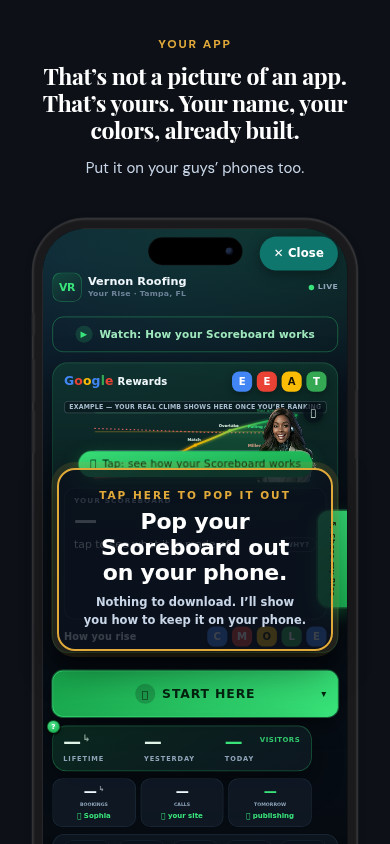
That’s not a picture of an app. That’s yours — the one that gets you found. Your name, your colors, already built.
I spent seventeen years as a public insurance adjuster, fighting the giants for people who rarely had the same tools the giants had. Since 1988, I have also been building systems designed for mass production.
Just your website address. No credit card. No sales call. No pitch.
Pop the hood.
Under the Hood — the whole machine
For those who like to geek out on new information — we took a look under the hood. Tap a section, then any question inside it.
Content Architecture3
Why does scanning the country for proven titles beat writing something fresh and local?
Because we're not guessing what to write. Hunter scans your trade across the country and brings back the exact blog titles already booking customers, town after town. By the time a topic reaches your business, it's been proven to work somewhere else first. Local guessing is a coin flip; proven-everywhere is a head start.
Would you rather publish what you HOPE ranks, or what's already proven to?
How does "gravity" on a title predict whether it'll actually rank for you?
Gravity is simple: it measures how widely a topic is already winning across the country. The more places it's pulling customers in, the heavier it pulls, and the more likely it ranks for you too. A topic winning all over isn't luck, it's a pattern. We hand you the heaviest hitters first, never the leftovers.
If a topic's already booking jobs all over the country, what are the odds it works in your area?
Why does one pillar with its clusters beat the same number of standalone posts?
Google trusts depth, not scatter. One main pillar page with its supporting clusters all linking together tells Google you're THE authority on that subject in your trade — a web, not a pile of lonely posts. Standalone pieces compete with each other for the same spot; a cluster makes every piece stronger.
Do you want twenty-five articles shouting alone, or twenty-five backing each other up?
The Sophia System4
How does Sophia turn a 20-minute voice memo into a full pillar and its clusters?
You just talk — about a job, a weird customer question, a "you won't believe what happened today." Sophia listens, asks questions back, and pulls the lessons out of your story. Each lesson becomes a pillar plus the supporting questions people actually search for. One ramble turns into a month of content only your business could've written.
What if the best content you'll ever publish is already in your head?
Why does talking it out beat typing up a brief?
Because you talk like someone who's actually done the work — and that's exactly what Google now rewards: real experience it can't fake. A typed brief is sterile; your spoken story carries the details, the proof, the voice. And it's effortless — your drive home becomes the easiest content session you'll ever do.
Who knows your trade better — a writer who Googled it, or you who lived it?
How does Sophia handle your Google reviews?
She keeps an eye on your Google Business Profile around the clock. The moment a new review lands — good or bad — she flags it and writes back a reply in your own voice, the way you'd say it. You read it, and if you like it, you tap once to post. No review sits ignored for three days while your top rival looks more responsive than you.
When a customer takes the time to review you, how fast do you want to be the one who answers?
Does Sophia actually remember me, or reset every time?
One Sophia, just for your business, for as long as you're with us — and she remembers every conversation. She's not starting over each morning; she's getting sharper about your business every single day. That's why she can greet you before coffee and already know what's going on in your territory.
Would you rather a tool that forgets you, or a chief of staff who knows you better every week?
Publishing Velocity2
How does daily harvesting keep up at four or five posts a day without choking?
Most "post more" plans choke because a human has to feed them. Daily harvest feeds itself — from the proven seed bank Hunter fills and from your own stories — so the queue never runs dry. Scaling to four or five a day isn't five times the work; the machine just keeps eating, always at a pace Google rewards.
What's the point of "post daily" if YOU'RE the bottleneck?
Why bank the overflow instead of just publishing everything at once?
On a big day you might dump fifteen ideas at once. Google won't let you publish all fifteen in one shot without a penalty, so we bank the extra and drip it, up to a few a day, for weeks. Your burst of energy becomes steady momentum instead of a flash that fizzles. The throttle is a governor, not a cap.
Would you rather flame out in a week, or out-publish your top rival for a month straight?
Google's Algorithm2
What do schema, cross-linking, and click-to-call actually do for E-E-A-T?
These are the things under the hood you'd never see and never want to touch — Weaver handles them. Schema tells Google exactly what your page is. Cross-links prove depth and authority. Click-to-call turns a reader into a phone call. Together they hit Experience, Expertise, Authoritativeness, and Trustworthiness — the four signals Google grades you on — automatically, on every post.
Want to hand-code that on every article forever, or never think about it again?
Why does the uniqueness test stop your own pages from cannibalizing each other?
If two of your pages say the same thing, they fight each other for the same spot and BOTH lose. Every article clears a 100 percent uniqueness test before it ever reaches you, so your pages lift each other instead of tripping each other up. Tools that spin near-duplicate content quietly sink the very sites that use them.
What good is publishing more if your own pages are competing against each other?
Competitive Intelligence3
How does Hunter watch competitors across the country?
Hunter only watches what's already public — what's ranking, what's being published, what's changing — the same signals any customer could see. It's not hacking and it's not sneaking; it's paying attention everywhere, at a steady, respectful pace. Just attention, at a scale and speed you could never spare the time for yourself.
When's the last time you had time to study every competitor in town?
Why does answering your top rival's every move compound your lead?
your top rival gets a bad review, raises prices, or publishes an article — and Hunter flags it to Sophia, who has your response out before you'd even have noticed. Do that every single day and the gap doesn't just hold, it widens. Small daily counters stack into a lead they can't catch.
How far ahead would you be if you answered every move the day it happened?
How do you out-publish your top rival without getting penalized?
If they publish one, you publish two; if they publish ten, we step it up — but always at a pace Google rewards, never one it punishes. The system is throttled on purpose to protect your rise, not to game the algorithm. You close the gap on offense without ever tripping a penalty on defense.
What happens to your top rival when, no matter what they do, you're always a step ahead — and never at risk?
Authority Multiplication3
How does Weaver make ten articles feel like a hundred to Google?
After a post goes live, Weaver shows up and links it to all the right siblings, so Google sees a connected web of authority instead of ten lonely pages. The links pass strength around, lifting the whole site at once. Ten well-woven articles outrank a hundred disconnected ones.
Would you rather have a hundred scattered posts, or ten that make each other stronger?
Why does one monthly video create a permanent citation back to your site?
You shoot a quick clip on your phone. We turn it into a pillar, push it to YouTube, and cite your business's site in the description. That's a brand-new link from the most authoritative video site on the planet — every single month, stacking up. We haven't found anyone else packaging this for the local guy; agencies charge thousands for far less.
What's a fresh citation from Google's own network, every month, worth to your business?
How do photos turn into more clicks?
When someone's searching at two in the morning, they click the result with the image — every time. Add your job snapshots and before-and-afters, and each one becomes a custom thumbnail on your post. So you're the one they tap, not the plain blue link sitting above you.
Two results side by side — which gets the click, the one with a picture or the one without?
Daily Intelligence3
What's in the Presidential Daily Briefing every morning?
Every morning, at the time you choose, Sophia’s built to hand you the state of your territory: ground gained overnight, views that rolled in while you slept, conversations on your site, what your top rival did, and exactly how we already countered it. your top rival wakes up to yesterday's news; you wake up to today's strategy. It's not magic — it's just watching everything, every day, and reporting only what matters.
Who wins the day — the one guessing, or the one briefed before coffee?
Why a daily briefing instead of a dashboard you have to go check?
Because a dashboard makes YOU do the work — log in, dig around, try to figure out what changed. The briefing flips that: Sophia does the digging and brings you only what moved, in plain English, at the time you pick. No login maze, no charts to decode. You hear what matters and get on with your day.
Would you rather hunt for the numbers, or have them handed to you before coffee?
Can I act on the briefing, or do I just read it?
You act on it, right there. See a competitor move you want answered? Tell Sophia and she sets it in motion. Want to send your tech a job? Say "tell Marcus to handle it" and she surfaces the message to him. The briefing isn't a report you file away — it's the desk you run your day from.
What's a morning report worth if you can't do anything with it on the spot?
Ecosystem Effects2
Why does a $1 start beat normal software pricing?
A dollar removes every reason to say "let me think about it." You're not deciding whether to spend ninety-nine dollars — you're deciding to spend a buck and SEE. By the time the machine's been running on your site for a few days, the value is obvious and the decision makes itself. Friction kills software signups; a dollar erases it.
What's left to think about when the risk is one dollar?
What do the first people in actually get?
You get me. The early ones are the people I build around — you tell me what is missing and I go and build it, and you watch it land. What I am not going to do is print a price on this page that I have not settled yet. When the terms for the early ones are set, they will be written in plain English and you will read them before anything changes.
Would you rather have a number on a page, or the man who picks up the phone?
Foundational Philosophy3
Why call it a production machine instead of a tool?
A tool is a thing you operate. You pick it up, you do the work, you put it down — and nothing happens while you sleep. This is built the other way round. It works the shift you cannot work: it writes, it watches the shop above you, and it keeps the score. You read what it made and you say yes or no. That is the whole of your job in it.
Do you want one more thing to operate, or something that runs the shift you are not there for?
Why did one guy on a balcony build this instead of a big company?
Because the big companies aren't building it for you. They chase the franchises and the chains with ad budgets bigger than your whole revenue. I built this for the little guy getting beaten by those budgets — lean, focused, no boardroom. One person who's done nothing but build production machines can out-engineer a committee any day.
Who do you trust more — a committee selling to everyone, or the guy who built this for exactly you?
This is one machine — so why is the whole crew (Hunter, Sophia, Weaver) better than separate tools?
Because they hand off to each other. Hunter finds what's working and what your top rival is doing. Sophia acts on it — books the job, answers the review, briefs you each morning. Weaver perfects it after it publishes, weaving your posts into one web of authority. Five separate tools can't talk to each other; one crew never drops the ball between them.
Do you want five logins that ignore each other, or one crew that passes the work down the line?
Get the app that gets you found — free to open
See where you actually stand, then save it to your phone. Everything else — the writing, the publishing, the getting found — happens inside the app.