Your bank account empties while your shop phone stays dead silent. Every week, another automatic fee clears your business account while you sit in your truck waiting for the phone to make a sound. You work hard, you know your craft, and you take pride in every single job you finish. Yet you feel completely invisible in your own town while middleman directories sell access to your trade.
That frustration is not your fault. You did not start your company to spend your evenings fighting for scraps on rented platforms. You simply want honest work at honest prices without paying a gatekeeper for permission to talk to your own neighbors.
That is why I built you a free app that fixes exactly this. It gives you the power to stop renting customer inquiries and start owning your local reach.
You can't buy an exclusive lead from Angi. But you can earn one. When a directory platform collects a project request, they do not hand it to just one company. They split it up, charge several pros for the exact same contact details, and create a race to the bottom before you can even introduce yourself.
“What a racket..”
Shared lead platforms force honest trades into an exhausting pricing war. You burn diesel driving to estimates only to find three other trucks already idling at the curb. The company that sold you the request already collected its cash from every single one of you. They get paid whether you win the contract or lose money on materials.
Good local contractors are tired of renting their own market. Many hardworking tradesmen try everything they can find just to get their name in front of local homeowners without getting squeezed by big directories.
“Thx Darren, I'm a contractor in Cleveland trying to work the internet passed Craigslist. Would like to talk to you about the stuff I would like to use for getting work in Cleveland. Because Behr is giving me a web site link to home depot and Behr.”
You can't keep paying and praying. But you can start counting. Searching for a straight porch.com review often leads you to the same hard truth about rented platforms. Relying on directory links or third-party platforms keeps you trapped in someone else’s house instead of building equity in your own digital property.
The homeowner on the other end is just as frustrated. She did not ask to have her contact information shared with half a dozen companies at dinner time. She typed her problem into a search box expecting a direct solution, only to get caught in a middleman machine that leaves everyone unhappy.
“You people are a bunch of SCAMMERS. For three days you LIED to me saying someone was coming to my house to mount a flat screen on the wall and for 3 days I was lied to. I purchased this service and noone shows up. Then on the 3rd day I call Angi only to have some Indian guy laugh at me because I was so angry. How do you people sleep at night scamming people like this? DO NOT USE ANGI!!! THEY WILL NOT FOLLOW UP ON THE SERVICE THAT YOU PAID FOR.”
When the platform fails, your trade carries the blame. Notice how the homeowner remembers the broken promise and the wasted days. The directory pocketed the fee, failed to deliver, and left real local tradesmen looking unreliable in the customer's eyes.
You can't beat Google, but you can make it choose you. I spent seventeen years as a public insurance adjuster fighting massive insurance giants for the little guy. I learned that small businesses rarely lose because they lack skill, but because nobody ever handed them the tools the big corporations use.
Local search visibility is pure physics, not magic. When I realized how search engines actually evaluate businesses, I saw the flaw in the agency pitch. It is not about buying clicks or renting forms from big marketplaces. It is about publishing clear, honest signals that demonstrate real authority.
You can't eat being the best-kept secret in town. But you can get found. Every top company dominating the local map pack follows a clear, tested recipe. To prove this, I studied top-ranking map companies across more than 900 different types of businesses and over 100 cities. I wrote down the complete strategy in my book, Cracking the Matrix: You Can’t Beat the System That Decides Who Gets Found. You Can Make It Choose You, available on Amazon.
The winning steps are already measured and waiting. You do not need to hire an expensive agency or sign an annual contract. Your file begins calibrating the moment your basic business details are checked against real national benchmarks.
Seeing your benchmark requires only two simple pieces of information. We do not need a sales call, a pitch, or your credit card. You simply provide your website address and your exact trade. That pulls back the curtain on Google's top Maps recipe for your trade and unlocks the free app that helps the system choose your business.
YOUR TRADES CALCULATED TOP MAPS RECIPE
Stop buying back your own neighborhood. Own it
The first step is knowing the recipe. Enter your trade to continue
Stop trusting a "vetted" lead. Grow real trust of your own.
Where you stand
Your own numbers, next to the Top Maps Recipe.
Every number on your side was taken off your own business while you were answering.
Your benchmark numbers reflect real companies already winning your trade. The scoreboard you see does not guess what works. It measures the real national average of shops currently sitting at the top of the map pack across the country.
Comparing your shop to a single local competitor is a mistake. That shop two exits down might just be lucky or coasting on ten years of old links. The national recipe reveals what the search engine actually rewards across thousands of searches, showing you the exact baseline you need to clear. There is no pitch here and no credit card, only proof.
No pitch. No credit card. Just proof.
Look back at what that contractor in Cleveland experienced. He was trying to figure out how to generate steady work on the internet without relying on classified listings or store affiliate links.
“Thx Darren, I'm a contractor in Cleveland trying to work the internet passed Craigslist. Would like to talk to you about the stuff I would like to use for getting work in Cleveland. Because Behr is giving me a web site link to home depot and Behr.”
If that contractor had published his own real-world proof, his reality would be different. He would not be looking for scraps or hoping a paint manufacturer links to his shop. Homeowners in his service area would find his real projects directly on Google without any middleman standing in the way.
The entire paid marketplace ecosystem runs on recurring pressure. Whether it is Porch, Angi, Bark, or Thumbtack, the story rarely changes. Service pros face pushy sales reps, difficult cancellation rules, and high monthly charges for inquiries sent to multiple contractors at once.
How does porch.com work for local service businesses? Like most lead brokers, the platform captures homeowner project requests online, then sells those project alerts to local service pros who pay a fee to bid against other contractors.
You do not need a credit card on file with lead brokers to get calls. The business owner sitting in the number one map spot in your town is not smarter than you. He simply understands how to feed search engines the exact signals they want to see every day.
Experience means showing the real work your hands do every week. It is your boots on the job site, your tools fixing a broken line, and your crew solving real problems. It is the practical knowledge you carry in your head every day.
Expertise, Authoritativeness, and Trust mean proving that knowledge publicly. When you consistently answer common trade questions and show completed jobs on your site, search engines recognize you as the verified authority in your city.
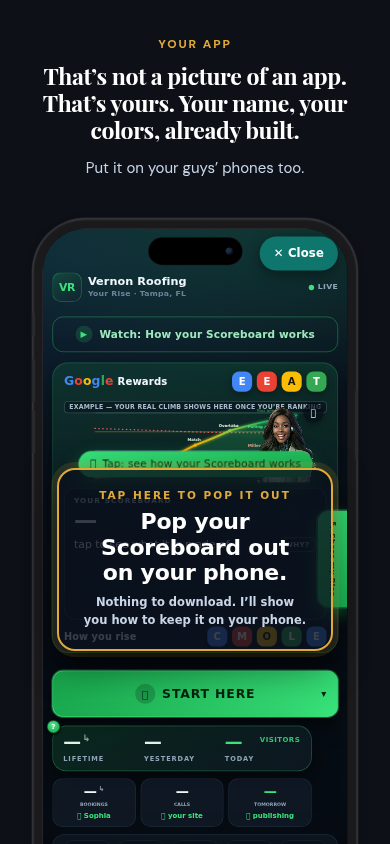
Tapping the letter buttons on the scoreboard explains every signal. Each button opens a simple breakdown showing why that specific signal matters, how search engines read it, and how your app helps you publish it without taking time away from your tools.
I built a tool to make sending these signals effortless. You already have the trade expertise in your mind. My system takes your everyday job stories and organizes them into the clean structure search engines prefer.
The Blog Scoreboard is built completely as an open glass box. Because lead companies hide their math behind closed doors, our data updates in real time inside your app. If search requirements shift, your custom app updates immediately so you never run an outdated plan.
Live metrics prove how steady visibility creates real value. Right now, this page shows views today, yesterday, and total views. Real views build authority over time without spending money on ads.
Owning your own customer pipeline changes your daily business. You get direct calls from homeowners who already want your expertise, keeping your crew scheduled without handing your margin over to a lead broker.
Your custom app is already built and waiting below. Because you entered your trade and website address, the system has already organized your baseline score. Setup takes only five minutes. You can watch the walkthrough videos right now in your browser with zero obligation, and simply saving the app to your phone's home screen unlocks the rest.
My second book outlines what happens when you control your pipeline. It is called Sick of Winning: The Local Business Owner’s Guide to Getting Found on Google, available on Amazon at amazon.com/dp/B0H8FC9FMH. When you build an engine that causes search engines to pick your company on their own, steady calls become your normal routine.
The one-dollar test lets you inspect the machinery yourself. For a single dollar, the system creates an entire Content family of properly formatted articles. These pieces contain clean Schema markup that links your topics together so search engines immediately recognize your local trade authority.
Every article starts from Seeds of Inspiration. These are not random writing prompts. They are measured search queries that top-performing competitors in your trade are already using to capture calls across the country.
Each Content family is presented directly to your thumb for review. You read the drafts on your phone. If something does not sound like your voice, you simply tap reject, state what needs adjusting, and receive a clean rewrite before anything publishes.
All published articles match your existing business brand. Every piece carries your company colors, your logo, and connects directly to your own web domain with full technical code included.
Activating the Daily Harvest engine puts your signals out for you, every day. For $99 a month—a grandfathered rate locked in forever for the first 1,000 users before the regular $499 rate begins—you unlock the complete publishing system. This engine steadily proves your Experience, Expertise, Authoritativeness, and Trust by documenting how your team solves everyday customer problems.
Talking to Sofia makes updating your website painless. On your drive home from a job, place your phone on the dash and tell Sofia about your day. Talk about the unusual pipe break you fixed or the questions the homeowner asked. The system turns your talk into a Pillar article and up to five related child articles, queued safely for your approval.
You can also feed the engine with photos and past stories. If you prefer not to talk, open your Seeds of Inspiration, choose a topic, and upload two to five photos from the job site. The system weaves those authentic pictures directly into your articles.
A monthly video powerhouse expands your reach even further. Once a month, record a short video explaining a recent job. The system formats it with an eye-catching thumbnail, uploads it to your YouTube channel with links back to your site, and extracts the top video frames to use as unique images across your written articles.
This test drive proves the underlying mechanics of owned search traffic. It will not transform your company overnight, but it shows you the exact path forward. If you choose not to activate the engine, your app remains yours with no high-pressure calls and no running clock.
Your app — it gets you found
That’s not a picture of an app. That’s yours — the one that gets you found. Your name, your colors, already built.
I spent seventeen years as a public insurance adjuster, fighting the giants for people who rarely had the same tools the giants had. Since 1988, I have also been building systems designed for mass production.
Just your website address. No credit card. No sales call. No pitch.
Pop the hood.
Under the Hood — the whole machine
For those who like to geek out on new information — we took a look under the hood. Tap a section, then any question inside it.
Content Architecture3
Why does scanning the country for proven titles beat writing something fresh and local?
Because we're not guessing what to write. Hunter scans your trade across the country and brings back the exact blog titles already booking customers, town after town. By the time a topic reaches your business, it's been proven to work somewhere else first. Local guessing is a coin flip; proven-everywhere is a head start.
Would you rather publish what you HOPE ranks, or what's already proven to?
How does "gravity" on a title predict whether it'll actually rank for you?
Gravity is simple: it measures how widely a topic is already winning across the country. The more places it's pulling customers in, the heavier it pulls, and the more likely it ranks for you too. A topic winning all over isn't luck, it's a pattern. We hand you the heaviest hitters first, never the leftovers.
If a topic's already booking jobs all over the country, what are the odds it works in your area?
Why does one pillar with its clusters beat the same number of standalone posts?
Google trusts depth, not scatter. One main pillar page with its supporting clusters all linking together tells Google you're THE authority on that subject in your trade — a web, not a pile of lonely posts. Standalone pieces compete with each other for the same spot; a cluster makes every piece stronger.
Do you want twenty-five articles shouting alone, or twenty-five backing each other up?
The Sophia System4
How does Sophia turn a 20-minute voice memo into a full pillar and its clusters?
You just talk — about a job, a weird customer question, a "you won't believe what happened today." Sophia listens, asks questions back, and pulls the lessons out of your story. Each lesson becomes a pillar plus the supporting questions people actually search for. One ramble turns into a month of content only your business could've written.
What if the best content you'll ever publish is already in your head?
Why does talking it out beat typing up a brief?
Because you talk like someone who's actually done the work — and that's exactly what Google now rewards: real experience it can't fake. A typed brief is sterile; your spoken story carries the details, the proof, the voice. And it's effortless — your drive home becomes the easiest content session you'll ever do.
Who knows your trade better — a writer who Googled it, or you who lived it?
How does Sophia handle your Google reviews?
She keeps an eye on your Google Business Profile around the clock. The moment a new review lands — good or bad — she flags it and writes back a reply in your own voice, the way you'd say it. You read it, and if you like it, you tap once to post. No review sits ignored for three days while your top rival looks more responsive than you.
When a customer takes the time to review you, how fast do you want to be the one who answers?
Does Sophia actually remember me, or reset every time?
One Sophia, just for your business, for as long as you're with us — and she remembers every conversation. She's not starting over each morning; she's getting sharper about your business every single day. That's why she can greet you before coffee and already know what's going on in your territory.
Would you rather a tool that forgets you, or a chief of staff who knows you better every week?
Publishing Velocity2
How does daily harvesting keep up at four or five posts a day without choking?
Most "post more" plans choke because a human has to feed them. Daily harvest feeds itself — from the proven seed bank Hunter fills and from your own stories — so the queue never runs dry. Scaling to four or five a day isn't five times the work; the machine just keeps eating, always at a pace Google rewards.
What's the point of "post daily" if YOU'RE the bottleneck?
Why bank the overflow instead of just publishing everything at once?
On a big day you might dump fifteen ideas at once. Google won't let you publish all fifteen in one shot without a penalty, so we bank the extra and drip it, up to a few a day, for weeks. Your burst of energy becomes steady momentum instead of a flash that fizzles. The throttle is a governor, not a cap.
Would you rather flame out in a week, or out-publish your top rival for a month straight?
Google's Algorithm2
What do schema, cross-linking, and click-to-call actually do for E-E-A-T?
These are the things under the hood you'd never see and never want to touch — Weaver handles them. Schema tells Google exactly what your page is. Cross-links prove depth and authority. Click-to-call turns a reader into a phone call. Together they hit Experience, Expertise, Authoritativeness, and Trustworthiness — the four signals Google grades you on — automatically, on every post.
Want to hand-code that on every article forever, or never think about it again?
Why does the uniqueness test stop your own pages from cannibalizing each other?
If two of your pages say the same thing, they fight each other for the same spot and BOTH lose. Every article clears a 100 percent uniqueness test before it ever reaches you, so your pages lift each other instead of tripping each other up. Tools that spin near-duplicate content quietly sink the very sites that use them.
What good is publishing more if your own pages are competing against each other?
Competitive Intelligence3
How does Hunter watch competitors across the country?
Hunter only watches what's already public — what's ranking, what's being published, what's changing — the same signals any customer could see. It's not hacking and it's not sneaking; it's paying attention everywhere, at a steady, respectful pace. Just attention, at a scale and speed you could never spare the time for yourself.
When's the last time you had time to study every competitor in town?
Why does answering your top rival's every move compound your lead?
your top rival gets a bad review, raises prices, or publishes an article — and Hunter flags it to Sophia, who has your response out before you'd even have noticed. Do that every single day and the gap doesn't just hold, it widens. Small daily counters stack into a lead they can't catch.
How far ahead would you be if you answered every move the day it happened?
How do you out-publish your top rival without getting penalized?
If they publish one, you publish two; if they publish ten, we step it up — but always at a pace Google rewards, never one it punishes. The system is throttled on purpose to protect your rise, not to game the algorithm. You close the gap on offense without ever tripping a penalty on defense.
What happens to your top rival when, no matter what they do, you're always a step ahead — and never at risk?
Authority Multiplication3
How does Weaver make ten articles feel like a hundred to Google?
After a post goes live, Weaver shows up and links it to all the right siblings, so Google sees a connected web of authority instead of ten lonely pages. The links pass strength around, lifting the whole site at once. Ten well-woven articles outrank a hundred disconnected ones.
Would you rather have a hundred scattered posts, or ten that make each other stronger?
Why does one monthly video create a permanent citation back to your site?
You shoot a quick clip on your phone. We turn it into a pillar, push it to YouTube, and cite your business's site in the description. That's a brand-new link from the most authoritative video site on the planet — every single month, stacking up. We haven't found anyone else packaging this for the local guy; agencies charge thousands for far less.
What's a fresh citation from Google's own network, every month, worth to your business?
How do photos turn into more clicks?
When someone's searching at two in the morning, they click the result with the image — every time. Add your job snapshots and before-and-afters, and each one becomes a custom thumbnail on your post. So you're the one they tap, not the plain blue link sitting above you.
Two results side by side — which gets the click, the one with a picture or the one without?
Daily Intelligence3
What's in the Presidential Daily Briefing every morning?
Every morning, at the time you choose, Sophia’s built to hand you the state of your territory: ground gained overnight, views that rolled in while you slept, conversations on your site, what your top rival did, and exactly how we already countered it. your top rival wakes up to yesterday's news; you wake up to today's strategy. It's not magic — it's just watching everything, every day, and reporting only what matters.
Who wins the day — the one guessing, or the one briefed before coffee?
Why a daily briefing instead of a dashboard you have to go check?
Because a dashboard makes YOU do the work — log in, dig around, try to figure out what changed. The briefing flips that: Sophia does the digging and brings you only what moved, in plain English, at the time you pick. No login maze, no charts to decode. You hear what matters and get on with your day.
Would you rather hunt for the numbers, or have them handed to you before coffee?
Can I act on the briefing, or do I just read it?
You act on it, right there. See a competitor move you want answered? Tell Sophia and she sets it in motion. Want to send your tech a job? Say "tell Marcus to handle it" and she surfaces the message to him. The briefing isn't a report you file away — it's the desk you run your day from.
What's a morning report worth if you can't do anything with it on the spot?
Ecosystem Effects2
Why does a $1 start beat normal software pricing?
A dollar removes every reason to say "let me think about it." You're not deciding whether to spend ninety-nine dollars — you're deciding to spend a buck and SEE. By the time the machine's been running on your site for a few days, the value is obvious and the decision makes itself. Friction kills software signups; a dollar erases it.
What's left to think about when the risk is one dollar?
What do the first people in actually get?
You get me. The early ones are the people I build around — you tell me what is missing and I go and build it, and you watch it land. What I am not going to do is print a price on this page that I have not settled yet. When the terms for the early ones are set, they will be written in plain English and you will read them before anything changes.
Would you rather have a number on a page, or the man who picks up the phone?
Foundational Philosophy3
Why call it a production machine instead of a tool?
A tool is a thing you operate. You pick it up, you do the work, you put it down — and nothing happens while you sleep. This is built the other way round. It works the shift you cannot work: it writes, it watches the shop above you, and it keeps the score. You read what it made and you say yes or no. That is the whole of your job in it.
Do you want one more thing to operate, or something that runs the shift you are not there for?
Why did one guy on a balcony build this instead of a big company?
Because the big companies aren't building it for you. They chase the franchises and the chains with ad budgets bigger than your whole revenue. I built this for the little guy getting beaten by those budgets — lean, focused, no boardroom. One person who's done nothing but build production machines can out-engineer a committee any day.
Who do you trust more — a committee selling to everyone, or the guy who built this for exactly you?
This is one machine — so why is the whole crew (Hunter, Sophia, Weaver) better than separate tools?
Because they hand off to each other. Hunter finds what's working and what your top rival is doing. Sophia acts on it — books the job, answers the review, briefs you each morning. Weaver perfects it after it publishes, weaving your posts into one web of authority. Five separate tools can't talk to each other; one crew never drops the ball between them.
Do you want five logins that ignore each other, or one crew that passes the work down the line?
Is porch.com legitimate? Yes, porch.com is a legitimate, publicly traded home improvement platform, but legitimacy does not guarantee that buying their leads will be profitable for your business. Many contractors find that paying for customer inquiries still leads to dead numbers, unreturned messages, and aggressive sales calls to keep accounts funded. Legitimacy simply means the company is a registered corporate entity, not that their rented lead model is the best way to secure profitable local jobs.
How much does Porch charge for leads? Lead fees on Porch typically range anywhere from twenty dollars to well over one hundred dollars per inquiry, depending strictly on your specific trade, your service market, and the estimated size of the job. Because lead prices fluctuate based on local demand and are charged before you ever speak with the customer, contractors often spend significant money each month before knowing whether a lead will result in real work.
How does porch.com work? Porch works by operating consumer-facing websites and home inspection software partnerships that prompt homeowners to request estimates for repairs and renovations. Once the homeowner submits a project description, Porch routes that inquiry to service professionals who have registered their business on the network and agreed to pay for incoming customer notifications. Contractors must then quickly contact the homeowner and compete against other service pros to bid on and win the project.
How does Porch Group make money? Porch Group generates its revenue by selling homeowner leads to contractors, charging monthly software subscription fees, and offering software tools to home inspectors, moving companies, and real estate professionals. By embedding its software into real estate transactions and home inspections, the parent company captures homeowner contact details early in the move process and monetizes those homeowner needs across its network of paid contractors and insurance services.
You can't ask Google for the recipe. But you can read it off the champions. The companies dominating search results in your city are not guessing their way to the top. They are hitting clear benchmarks that search engines reward with direct customer calls.
A clear gap exists between where your business sits and where the leaders operate. Knowing that gap is the first step toward building a predictable schedule that you own completely.
THE CLOSE
The record of the paid lead generation industry is clear. You can keep paying middleman directories for shared phone numbers, or you can start building equity in your own name.
The tool waiting on this page gives you a transparent look at where your website stands compared to the top shops in your trade nationwide. It is called Blog Scoreboard. It requires no credit card and no sales call, giving you the clear benchmark numbers you need to decide your own next move.
Get the app that gets you found — free to open
See where you actually stand, then save it to your phone. Everything else — the writing, the publishing, the getting found — happens inside the app.